

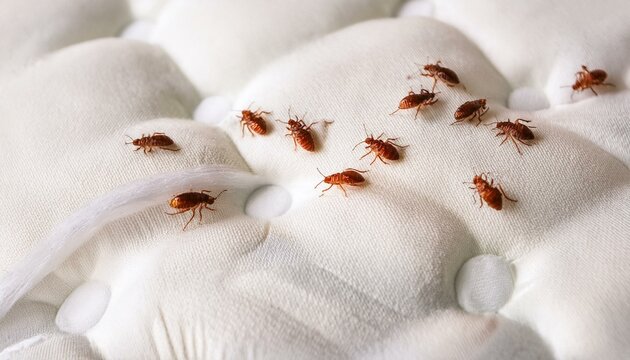
You’re waking up with itchy welts. Something is clearly biting you, but you haven’t been able to catch the culprit in the act. You’ve searched your mattress and maybe found a tiny bug or two, but you’re not sure what you’re looking at. This is the exact situation that leads to dozens of calls to Hot Bugz every month from Denver residents who need a definitive answer before they spend money on the wrong treatment. Bed bugs, carpet beetles, and fleas are the three pests most commonly confused with each other, and misidentifying which one you’re dealing with can send you down an expensive and frustrating dead end.
What Bed Bugs Look Like Up Close
Adult bed bugs are flat, oval, and reddish-brown. They’re roughly the size of an apple seed, about 4 to 5 millimeters long. After feeding, their bodies swell and darken to a deeper mahogany color. Unfed bed bugs are flatter and lighter, sometimes closer to a tan or light brown.
Nymphs (juveniles) are smaller and harder to spot. Recently hatched nymphs are nearly translucent and only about 1 millimeter long. They darken as they mature through five molting stages before reaching adulthood. If you see a tiny, pale, seed-shaped insect on your mattress seam, that’s likely a nymph.
Bed bugs don’t have wings and they don’t jump. They crawl, and they’re surprisingly fast when they want to be. You’ll most often find them along mattress piping, in box spring folds, behind headboards, and in the seams of upholstered furniture. Their fecal stains look like small dark dots, almost like someone dabbed a fine-tip Sharpie on the fabric.
How Bed Bug Bites Present
Bed bug bites tend to appear in clusters or lines, often three in a row, sometimes called a “breakfast, lunch, and dinner” pattern. They’re usually on exposed skin: arms, shoulders, neck, and face. The bites are red, raised, and itchy, and they often take a day or two to appear after the actual bite, which makes it harder to connect the bite to a specific moment.
Some people barely react to bed bug bites. Others develop significant welts. About 30 percent of people bitten by bed bugs show no visible skin reaction at all, which is one reason infestations can go undetected for weeks.
What Carpet Beetles Look Like (and Why They Cause Confusion)
Carpet beetles are small, round, and often patterned with white, brown, and orange scales. The most common species in Denver homes is the varied carpet beetle, which is about 2 to 3 millimeters long. They look nothing like bed bugs if you get a close look at one, but at a glance, the tiny dark shape on your sheets can trigger the same alarm.
Here’s the key distinction: carpet beetles don’t bite. They don’t feed on blood at all. Adult carpet beetles eat pollen and are sometimes found near windows. It’s the larvae that cause problems indoors. Carpet beetle larvae are small, fuzzy, caterpillar-like creatures that feed on natural fibers like wool, silk, and animal hair. They’ll eat through sweaters, rugs, and upholstery.
Why People Think Carpet Beetles Are Biting Them
The skin reactions people attribute to carpet beetle “bites” are actually allergic responses to the larvae’s tiny barbed hairs. When those hairs contact skin, some people develop itchy, red welts that look remarkably similar to insect bites. The pattern tends to be more scattered than bed bug bites and often appears on areas covered by clothing rather than exposed skin, since the irritation happens where fabric touches the body.
If you’re finding small, round bugs on your windowsills, tiny fuzzy larvae in your closet, and you have itchy welts that don’t follow the cluster pattern typical of bed bugs, carpet beetles are the more likely culprit. The treatment is completely different: thorough vacuuming, cleaning or dry-cleaning affected fabrics, and targeted insecticide application to areas where larvae feed. Heat treatment for bed bugs won’t be necessary.
What Fleas Look Like and How They Behave Differently
Fleas are thin, dark brown, and laterally compressed, meaning they’re flat from side to side rather than top to bottom like bed bugs. They’re about 1 to 3 millimeters long and, critically, they jump. If the tiny bug you caught on your skin launched itself away when you tried to grab it, that’s almost certainly a flea. Bed bugs can’t jump at all.
Fleas are most commonly associated with pets, but they can establish themselves in homes without animals. They breed in carpet fibers, pet bedding, and upholstered furniture, and they’ll bite humans when their preferred host isn’t available.
How Flea Bites Differ from Bed Bug Bites
Flea bites are typically concentrated on the lower legs and ankles. If you’re getting bitten primarily from the knees down, fleas are the most likely explanation. The bites are small, red, and intensely itchy, often with a hard, raised center that bed bug bites usually lack.
Flea bites also tend to appear immediately or within hours of the bite, unlike bed bug bites, which can take 24 to 72 hours to show up. If you sit on your couch and notice new bites on your ankles within the hour, that timing points to fleas.
Another telltale sign: flea dirt. If you see tiny black specks in your carpet or on your pet’s bedding, place them on a damp white paper towel. If they dissolve into reddish-brown streaks, that’s flea feces (digested blood). Bed bug fecal stains are also dark, but they’re typically found on mattresses and furniture seams, not in carpet fibers.
When the Identification Isn’t Clear
Sometimes the signs overlap enough that you genuinely can’t tell what you’re dealing with from bites and behavior alone. Some people react to bed bug bites on their legs. Some people find carpet beetle larvae near their bed. Fleas can bite anywhere on the body if the infestation is heavy enough.
That’s when capturing a specimen helps. If you can trap the bug in a piece of clear tape or a small sealed bag, you’ve got something a professional can identify definitively. Even a crushed specimen is useful if the body parts are intact enough to distinguish shape and features.
Photos help too, but they need to be close enough to show detail. A blurry phone photo of a speck on your pillow won’t tell anyone much. Use your phone’s macro mode or take the photo in bright light from as close as your camera will focus.
Let Hot Bugz Tell You What You’re Dealing With
The worst outcome is treating the wrong pest. Spending $500 on bed bug heat treatment when you actually have carpet beetles wastes money. Applying flea treatment when you have bed bugs gives you a false sense of security while the real problem grows. Identification has to come first.
Hot Bugz offers inspections specifically designed to answer this question. Their technicians know what to look for and where to look, and they’ll give you a straight answer about whether you’re dealing with bed bugs, carpet beetles, fleas, or something else entirely. If it is bed bugs, they can schedule heat treatment quickly. If it’s not, they’ll point you toward the right solution rather than selling you a service you don’t need.
